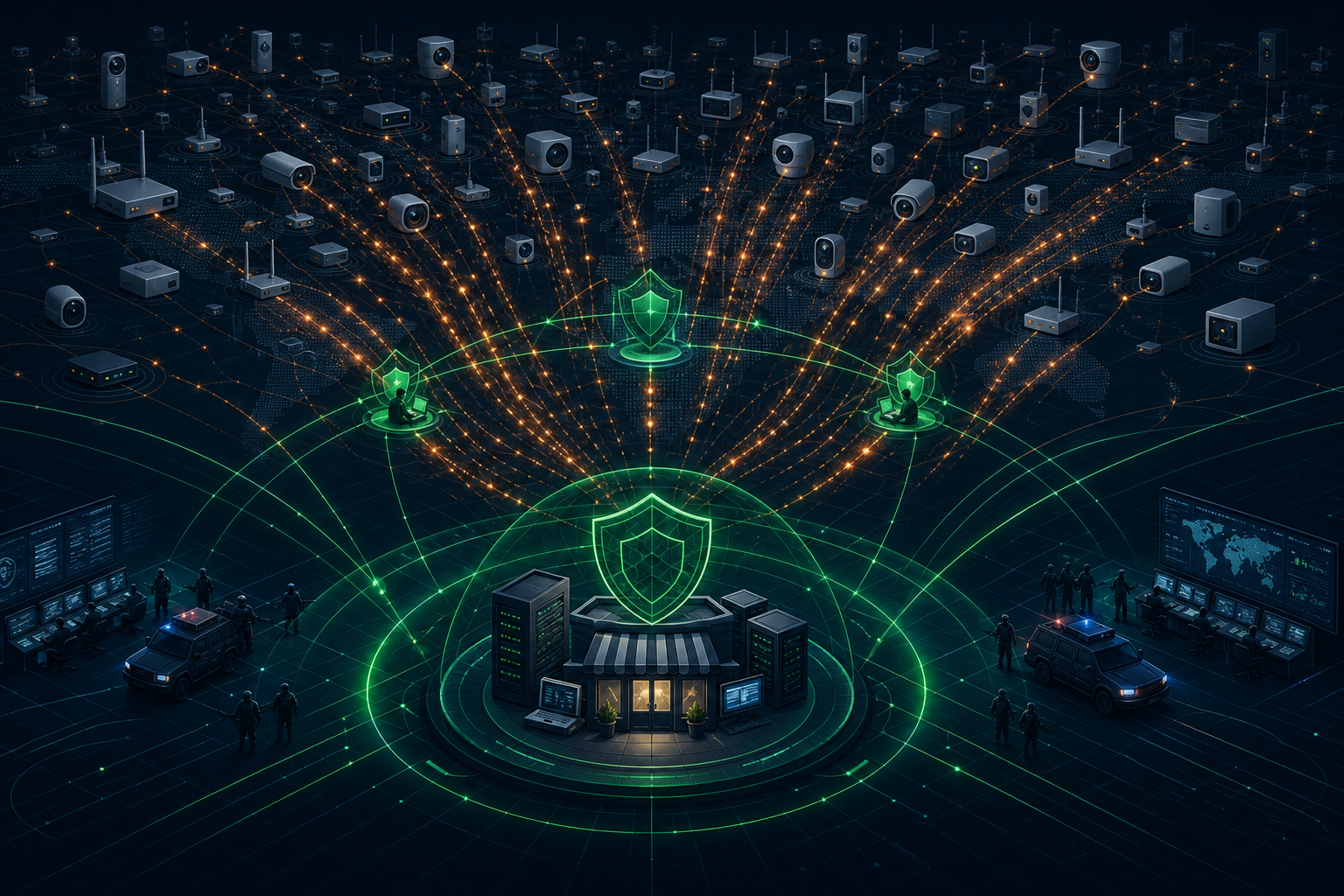
KrebsOnSecurity reported that Canadian authorities arrested a 23-year-old Ottawa man alleged to have built and operated the Kimwolf Internet-of-Things botnet, with U.S. charges also unsealed in Alaska. The case matters because Kimwolf was not just another noisy botnet. It was tied to DDoS attacks measured near 30 Tbps, more than 25,000 attack commands, and targeting that included Department of Defense address ranges.
For small businesses, local governments, and government contractors, the lesson is blunt: DDoS risk does not only come from your own web server. It can originate from the forgotten devices in everyone else’s networks, and it can still land on your help desk, public portal, VPN concentrator, DNS provider, or customer-facing application.
What happened
According to KrebsOnSecurity, the alleged operator, Jacob Butler, also known as “Dort,” was arrested in Canada under a U.S. extradition warrant. The Justice Department previously said KimWolf was one of four major IoT botnets disrupted in March 2026 alongside Aisuru, JackSkid, and Mossad. Those botnets collectively infected millions of devices and were used in a cybercrime-as-a-service model to sell DDoS capability to other actors.
The devices at issue were not exotic. Reporting and law-enforcement statements describe common IoT and edge equipment such as webcams, routers, digital video recorders, and other poorly managed devices. That is exactly why the threat scaled: cheap hardware, weak update practices, internet exposure, and device owners who often never know they are part of an attack.
Why this matters
The arrest is good news, but it should not create false comfort. DDoS crews recover, rebrand, and compete for the same vulnerable device populations. Takedowns disrupt infrastructure and can remove individual operators, but they do not automatically clean infected endpoints or fix the market incentives that make booter services profitable.
For SMBs and government contractors, the operational risk is service availability. A DDoS event can interrupt proposal portals, customer support, telephony, payment systems, remote access, and email security gateways. For organizations supporting public-sector work, downtime can quickly become a contractual, reputational, and incident-reporting problem.
Defensive takeaways
- Know what must stay online. Identify public-facing systems that are mission-critical: websites, DNS, VPN, SSO, email gateways, VoIP, APIs, and customer portals.
- Use upstream DDoS protection. Do not wait until an attack starts to discover what your ISP, CDN, DNS provider, or hosting company can absorb.
- Separate public services from internal access. Keep administrative interfaces, VPN portals, and management consoles off the open internet wherever possible.
- Harden your own IoT and edge devices. Replace default credentials, disable UPnP where practical, update firmware, segment cameras and appliances, and retire unsupported hardware.
- Exercise the contact path. Make sure someone knows who to call at the ISP, DNS provider, CDN, host, and incident-response partner during an availability event.
- Log before you need it. Preserve firewall, WAF, DNS, CDN, and identity logs so you can distinguish volumetric DDoS from credential abuse or application-layer exploitation.
Bulwark Black assessment
Kimwolf is a reminder that basic internet hygiene is still national-scale security work. A neglected camera or router may seem irrelevant to one household or small office, but at botnet scale those devices become rented infrastructure for extortion, harassment, and attacks against public-sector networks.
The practical move is not panic. It is preparation: reduce your own exposed device footprint, confirm upstream DDoS coverage, and document the response path before the traffic starts. Availability is a security control, and for small teams it has to be planned before it is needed.
Original reporting: KrebsOnSecurity. Additional background: U.S. Department of Justice March 2026 botnet disruption announcement.