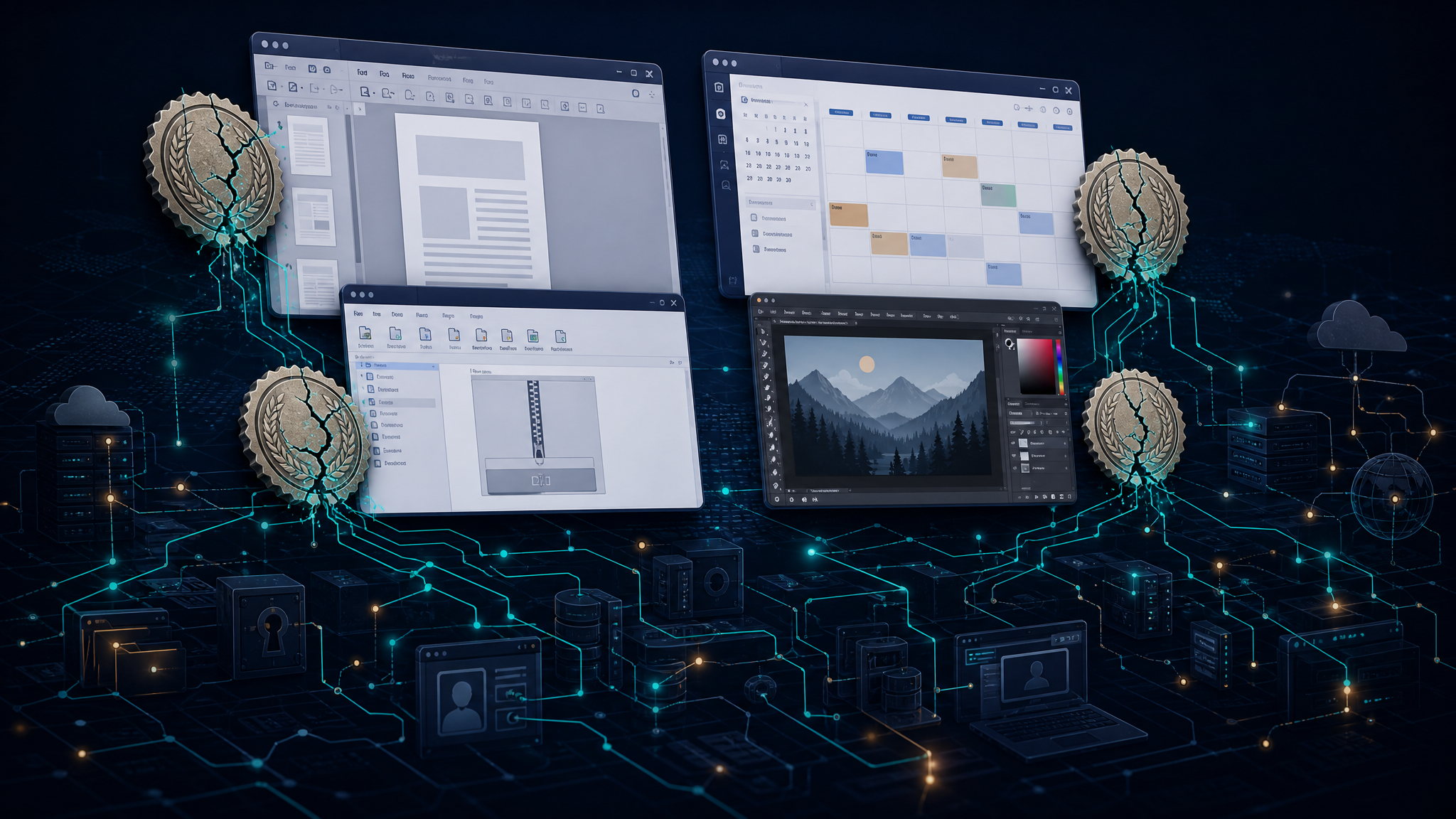
Unit 42’s latest research on TamperedChef-style activity is a useful reminder that “signed” and “functional” do not automatically mean “safe.” The campaign clusters they describe package malware inside convincing productivity applications — PDF tools, calendar apps, archive utilities, and image tools — that often work well enough to avoid immediate user suspicion.
The key problem is trust transfer. Users see a polished website, a normal installer, a code-signing certificate, and a tool that appears to do what it promised. Defenders may see the same signals and classify the software as nuisanceware or potentially unwanted software. According to Unit 42, these applications can remain dormant for weeks or months, maintain command-and-control capability, and later retrieve payloads such as information stealers, proxy tooling, or remote access trojans.
That matters for small businesses and government contractors because these environments often allow users to install “one-off” tools to solve immediate workflow problems: compressing files, editing PDFs, converting images, or managing calendars. Those small exceptions can become durable access paths if the application later activates, steals browser sessions, or installs additional tooling.
What Unit 42 Reported
Unit 42 tracks several overlapping TamperedChef-style clusters, including CL-CRI-1089, CL-UNK-1090, and CL-UNK-1110. Across the activity, researchers identified more than 4,000 file hashes, over 100 unique variants, and 81 code-signing organizations associated with the broader pattern.
The activity is especially slippery because it blends software supply-chain abuse, malvertising, code signing, dormancy, and legitimate functionality. The fake applications are not always obvious junk. Many are distributed through credible-looking domains, modern landing pages, legal language, contact pages, and CDN-hosted installers.
Source: Unit 42 — Tracking TamperedChef Clusters via Certificate and Code Reuse
Why This Is More Than Adware
The old mental model says adware is annoying, malware is dangerous, and the two are separate. TamperedChef-style activity breaks that line. If a productivity app can persist, communicate with remote infrastructure, retrieve arbitrary payloads, and deploy stealers or RATs, it should be handled as a security incident rather than a cleanup ticket.
The dormancy window is the dangerous part. A machine may look clean during installation and only become visibly malicious weeks later. By then, browser sessions, saved credentials, SaaS access, VPN profiles, and cloud tokens may already be exposed.
Defensive Takeaways
- Treat unsanctioned productivity apps as a real risk category. PDF editors, ZIP tools, converters, image utilities, and “free” calendar apps deserve the same scrutiny as remote access tools.
- Do not rely on code signing alone. A valid signature can improve reputation, but it does not prove intent or safety.
- Use application control where possible. For SMBs, this can start with a simple approved-software list and blocking installers from user-writable paths.
- Watch for delayed execution. Hunt for newly installed applications that begin making network connections or spawning unexpected child processes days or weeks after install.
- Monitor browser and identity signals. Infostealer activity often becomes an identity incident: suspicious SaaS logins, new OAuth grants, mailbox rule changes, token reuse, or impossible travel.
- Separate user convenience from production trust. Contractors handling client, CUI, proposal, or financial data should not allow random freeware installs on systems used for sensitive work.
Bulwark Black Assessment
TamperedChef is not just a malware family story. It is a policy failure pattern. Attackers are betting that organizations will accept polished software, signed binaries, and user convenience as enough proof of safety. That is a weak control model.
The practical answer is not to ban every utility tool overnight. The proper approach is to build a lightweight software intake process: approved sources, hash or vendor validation for common tools, endpoint telemetry for new installs, and a clear rule that unknown “free productivity” software does not belong on systems with privileged access or sensitive data.
For government contractors, this also supports compliance hygiene. Software inventory, least privilege, controlled installation rights, and endpoint monitoring are not paperwork exercises — they are how you keep a fake PDF tool from becoming an identity breach.