
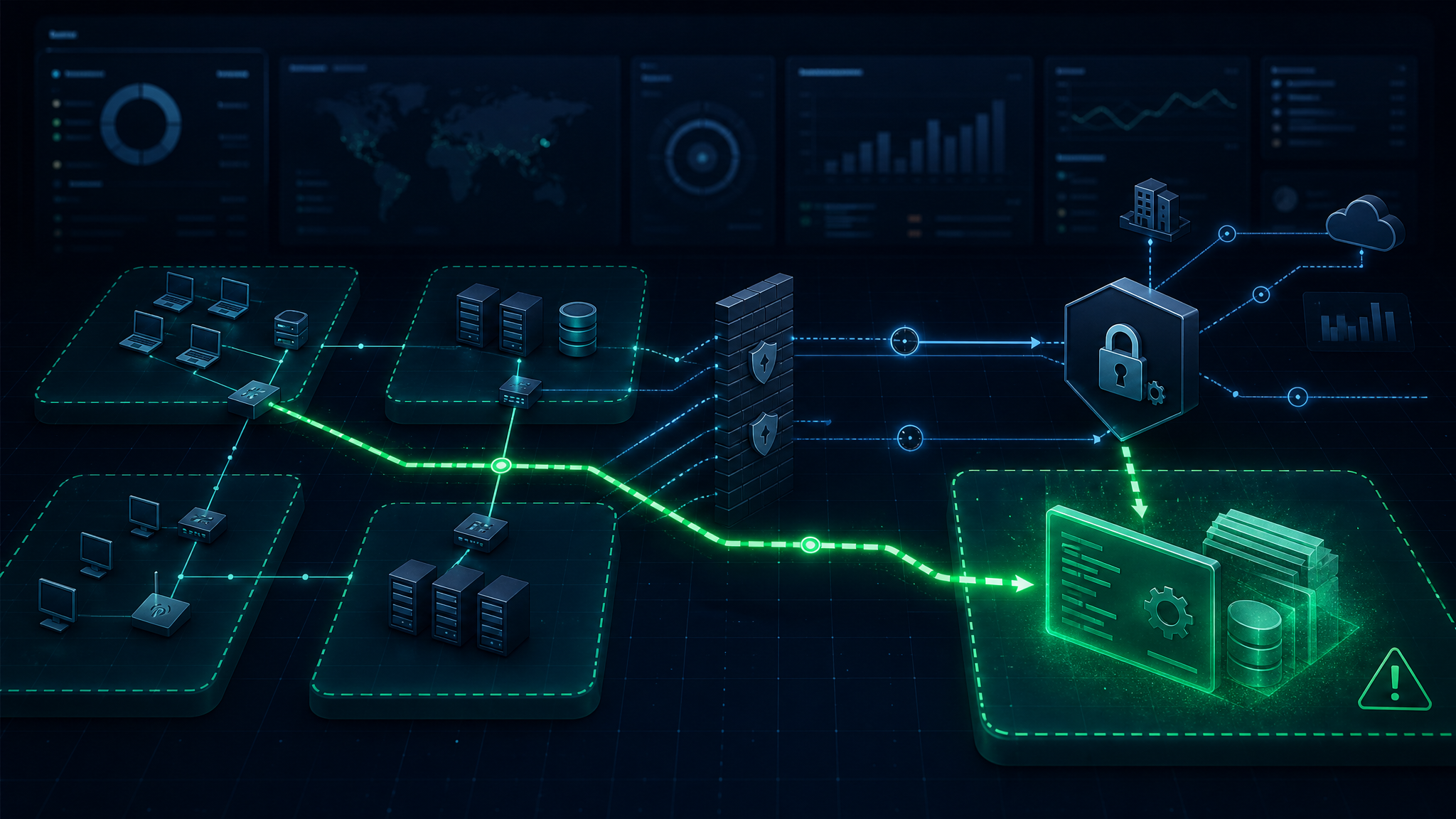
Fortinet has published FG-IR-26-140 for CVE-2026-49938, an improper access-control issue in FortiPortal API endpoints. The advisory rates the vulnerability as medium severity with a CVSSv3 score of 6.2, but the practical risk deserves attention because the exposed data is not ordinary application noise: Fortinet says a remote authenticated attacker with an organization user role may be able to obtain sensitive network configuration data through crafted HTTP requests.
For managed service providers, government contractors, and small organizations that rely on Fortinet tooling, that distinction matters. Network configuration data can reveal firewall policy structure, interface names, routing assumptions, VPN relationships, segmentation boundaries, customer environments, and the shape of the defensive perimeter. Even when a vulnerability does not provide code execution or full administrative control, it can still hand an attacker the map they need for later intrusion planning.
What Fortinet reported
Fortinet describes the issue as CWE-284: Improper Access Control affecting FortiPortal API endpoints. The vulnerable versions listed by Fortinet are:
- FortiPortal 7.4: versions 7.4.0 through 7.4.7 — upgrade to 7.4.8 or later.
- FortiPortal 7.2: versions 7.2.0 through 7.2.8 — upgrade to 7.2.9 or later.
- FortiPortal 7.0: all versions — migrate to a fixed release.
The attack type is authenticated, Fortinet lists no known exploitation as of the advisory publication, and the issue was externally discovered. The NVD entry for CVE-2026-49938 also references Fortinet’s vendor advisory.
Why this is bigger than the CVSS score
Security teams tend to triage vulnerabilities by severity labels, and that is understandable when patch queues are overloaded. But edge and management-plane products need a second lens: what could the exposed information help an attacker do next?
FortiPortal is used to centralize administration, reporting, and customer-facing visibility around Fortinet environments. If an organization user can reach network configuration data they should not be able to access, the blast radius depends on how FortiPortal is deployed, how tenants or organizations are separated, and what the instance knows about downstream devices and networks.
For a threat actor, configuration data can become reconnaissance at scale. It can identify interesting VPNs, trusted routes, naming conventions, security zones, policy gaps, exposed services, and targets worth phishing or password spraying. For an MSP or contractor supporting multiple customers, the risk is not just one environment. It is the possibility that a low-privilege account in a portal context can expose details that make multiple environments easier to attack.
Defensive takeaways
- Patch or migrate first. Upgrade FortiPortal 7.4 to 7.4.8 or later, FortiPortal 7.2 to 7.2.9 or later, and move any 7.0 deployment to a fixed release path.
- Review organization user roles. Confirm which accounts have organization-level access and whether those accounts still need it. Remove stale users, shared accounts, and over-broad customer access.
- Audit API access patterns. Look for unusual API requests from organization user accounts, especially requests that do not match normal portal workflows or originate from unexpected IP ranges.
- Treat config exposure as incident-relevant. If logs suggest suspicious access, assume the attacker may have learned network topology and security policy details. Rotate exposed secrets if configurations include credentials, tokens, VPN material, or sensitive integration data.
- Segment management portals. FortiPortal and similar management systems should not be casually reachable from the internet or broad internal networks. Put access behind VPN/ZTNA, strong MFA, conditional access, and logging that security staff actually review.
- Check tenant boundaries. MSPs and multi-organization environments should validate that users cannot enumerate or retrieve data outside their assigned customer scope.
Bulwark Black assessment
CVE-2026-49938 is not the loudest kind of vulnerability. It is not described as unauthenticated remote code execution, and Fortinet says there is no known exploitation. But it sits in a category that defenders should not dismiss: management-plane data exposure.
Attackers do not need every vulnerability to be a shell. Sometimes the win is a better target list, a clearer view of firewall policy, or enough network context to make the next phishing email, credential attack, or lateral movement path more precise. For SMBs, MSPs, and government contractors, the practical move is simple: patch the affected FortiPortal versions, reduce organization-user access to the minimum necessary, and review whether any management portal can reveal more about the network than a low-privilege account should know.
Original source: Fortinet PSIRT FG-IR-26-140. Additional reference: NVD CVE-2026-49938.