












A clean download URL today is not proof that yesterday's updater alert was harmless. For small businesses and government contractors, that distinction should change how suspicious activity from trusted software is investigated.
Source reporting: Google Threat Intelligence Group and Mandiant: Investigating Ephemeral Supply Chain Tampering, published October 15, 2026. The operational recommendations below are Bulwark Black analysis.
What researchers reported
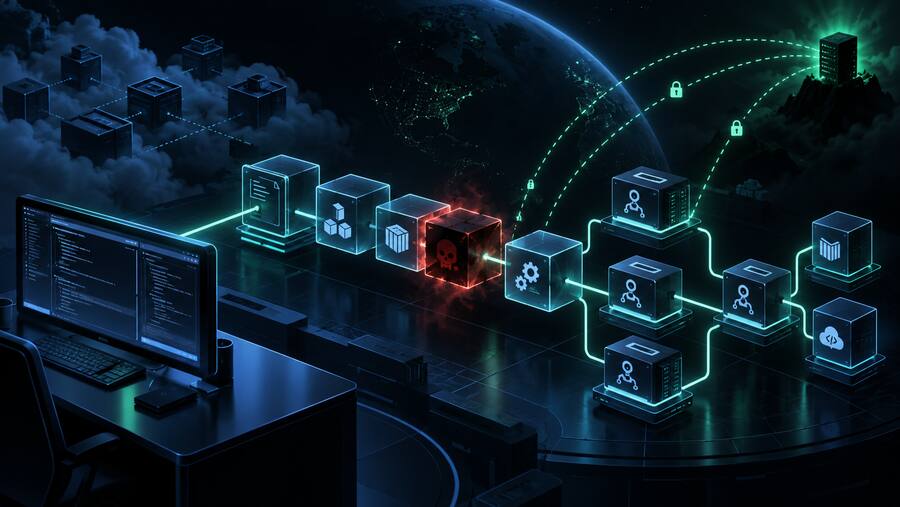
GTIG and Mandiant investigated tampering with AOMEI's software distribution infrastructure between April and July 2026, tracking the activity as UNC7017. Update and notification configurations were changed for five-to-ten-minute intervals, then restored. Clients polling during those intervals could receive malicious instructions; later checks could see legitimate files.
The reported payload chain included the CROSSROAD downloader and SHINYROAD backdoor. Researchers described scheduled-task persistence and abuse of legitimate administration software. AOMEI told researchers it had taken corrective action, but restoring distribution servers does not remove payloads already installed on endpoints. The report does not establish that every AOMEI installation was compromised.
The defensive failure mode: checking the present to explain the past
Bulwark Black assessment: A triage procedure that treats a currently clean vendor URL as a reason to close an endpoint alert creates a blind spot. The relevant question is what the endpoint actually retrieved and executed at the time of the event, not whether a fresh request looks safe hours later.
For a lean security team, the answer is not to retain every network packet indefinitely. It is to establish a small, useful evidence set: synchronized timestamps, process ancestry, executable and module hashes, destination records, and retained updater artifacts where available. Confirm that your managed detection provider can supply that evidence before an incident forces the question.
A practical response checklist for SMBs and contractors
- Establish exposure before declaring an incident. Inventory installed backup and remote-access products across managed devices, including administrator workstations and less-visible support systems. Identify owners, installation paths, update policies, and available historical telemetry. Installation alone is not evidence of compromise.
- Preserve the event timeline. When an updater triggers suspicious behavior, capture its parent-child process chain, command lines, related files, and associated network events. Preserve relevant artifacts before uninstalling or cleaning up software, where operationally feasible. Record time zones and collection gaps explicitly.
- Hunt for behavior, not just vendor names. Correlate updater execution with unexpected programs, new persistence, unusual DLL loads, and unapproved remote-management activity. A signed executable is useful context, not a blanket clearance for every module it loads.
- Separate containment from restoration. If corroborating evidence indicates compromise, isolate affected systems through your incident-response process. Evaluate which credentials and resources those systems could access. Make recovery and credential decisions from the observed exposure, rather than assuming a vendor-side fix repaired the endpoint.
- Use the research as a hunt package. The linked report supplies campaign indicators and detection material. Validate those against your environment and investigate matches in context. Avoid blocking entire cloud-storage platforms merely because an attacker used one; prefer specific malicious resources and abnormal process-to-destination relationships.
- Document the decision. Keep a concise case record covering affected assets, evidence, containment, recovery validation, and unresolved uncertainty. For government contractors, have the designated incident lead assess contractual reporting obligations rather than inventing a deadline from a news story.
Questions to ask software suppliers
Ask how clients authenticate update metadata and downloaded packages independently of the connection that delivers them. Ask whether remotely supplied notification settings can cause local execution, and how those capabilities are constrained. Request an explanation of update-infrastructure change detection and what historical evidence would be available to a customer investigating a specific timestamp.
For your own team, test one scenario: an approved updater launches an unexpected program, but its website now serves a clean file. Can the analyst preserve the original evidence and escalate without being overruled by a reassuring reputation check? A short tabletop exercise can expose that procedural weakness without waiting for another supply-chain incident.
Bottom line
Trusted software still needs behavioral scrutiny. Treat a clean present-day download as one data point, preserve evidence from the original event, and distinguish supplier remediation from endpoint recovery.