














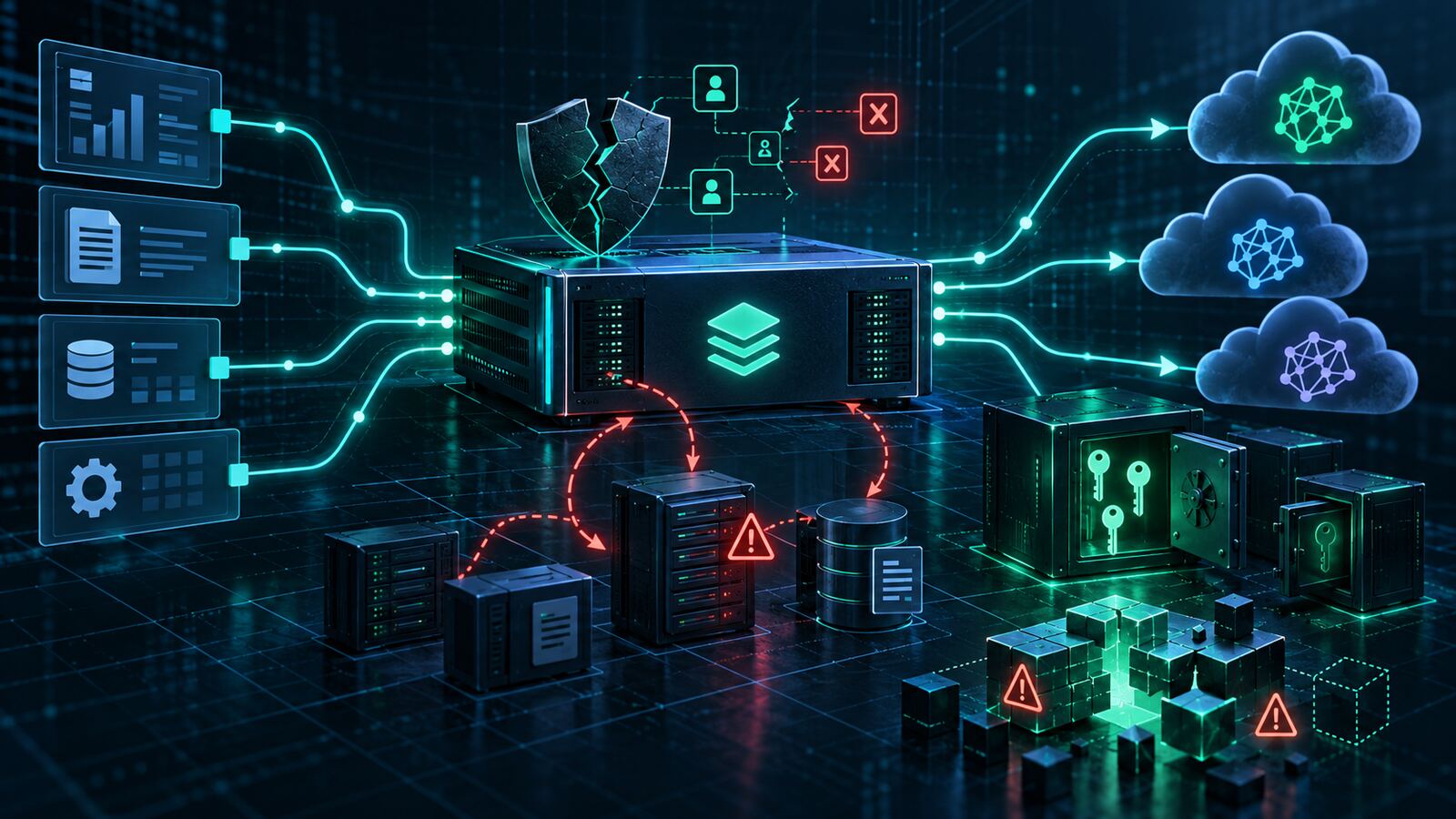
LLM gateways are quickly becoming a control point for modern AI applications. They route model requests, manage provider keys, enforce usage policies, and centralize logging. That makes them useful — but it also makes them high-value infrastructure. If the gateway is weak, attackers may not need to compromise the model provider or the application. They can compromise the broker in the middle.
Check Point Research published new findings on LiteLLM gateway vulnerabilities affecting version 1.77.7 and resolved in version 1.83.9. The reported issues include an access-control failure in a configuration endpoint, arbitrary file read, administrative account takeover paths, remote code execution through pass-through endpoint configuration, and a separate SSRF weakness tied to client-side LLM credential handling.
Original research: Check Point Research — When LLM Gateways Go Wrong: Findings from LiteLLM.
What happened
According to Check Point, the most important flaw was not an exotic AI-specific weakness. It was a missing authorization check on a sensitive configuration update endpoint. Any authenticated user, including a lower-privileged user, could reach functionality that should have been limited to proxy administrators.
That matters because the gateway configuration can influence runtime behavior, environment variables, credential handling, and pass-through routes. In the reported attack chain, changing configuration could expose files available to the LiteLLM process, overwrite administrative UI credentials, or load attacker-controlled Python modules from remote storage.
Check Point also reported an SSRF issue in LiteLLM’s client-side LLM credentials feature. In plain language: a gateway designed to safely broker requests to AI providers could be redirected in ways that risked exposing provider credentials.
Why this matters for SMBs and government contractors
Many organizations are adopting AI infrastructure faster than they are adapting their security model. A gateway can feel like a simple developer convenience, but in production it may hold API keys, cloud permissions, billing access, prompts, logs, customer data, and internal routing logic.
For small businesses and government contractors, this risk is especially practical. Teams may deploy LiteLLM or similar tools to control cost and standardize access to multiple models. If the gateway is exposed, loosely permissioned, or running with broad cloud access, it can become an attacker’s shortcut into both AI workflows and the surrounding network.
Defensive takeaways
- Upgrade LiteLLM. Check Point states the issues were resolved in LiteLLM version 1.83.9. Inventory any LiteLLM gateway deployments and update them before treating the environment as clean.
- Restrict who can change gateway configuration. Runtime configuration updates should require explicit admin authorization, strong authentication, and change logging.
- Do not expose AI gateways directly to the internet. Put them behind VPN, private networking, identity-aware access, or a hardened reverse proxy with clear allowlists.
- Scope provider keys tightly. Model-provider API keys should be environment-specific, revocable, and limited by budget, tenant, and operational need where supported.
- Watch egress from the gateway. SSRF and remote module loading risks become much more dangerous when the server can freely reach cloud metadata endpoints, storage buckets, internal admin panels, or arbitrary internet hosts.
- Log configuration changes as security events. Alert on new pass-through endpoints, environment variable changes, admin credential changes, new model routes, and unusual outbound destinations.
- Separate development and production AI infrastructure. Developer experimentation should not share the same gateway, secrets, or network path as production workloads.
Bulwark Black assessment
This is a good reminder that AI security is still infrastructure security. The headline involves an LLM gateway, but the root lessons are classic: broken access control, secret exposure, SSRF, overpowered runtime configuration, and insufficient network segmentation.
The organizations most at risk are the ones treating AI middleware like a sidecar utility instead of a privileged service. If a gateway can read secrets, rewrite config, call providers, and reach internal systems, then it deserves the same hardening attention as an identity provider, API gateway, or CI/CD controller.
For defenders, the immediate priority is simple: find every AI gateway, patch it, lock down administrative routes, rotate exposed credentials if compromise is suspected, and make outbound traffic visible. AI tooling is moving fast, but the controls that prevent this class of failure are well understood.