







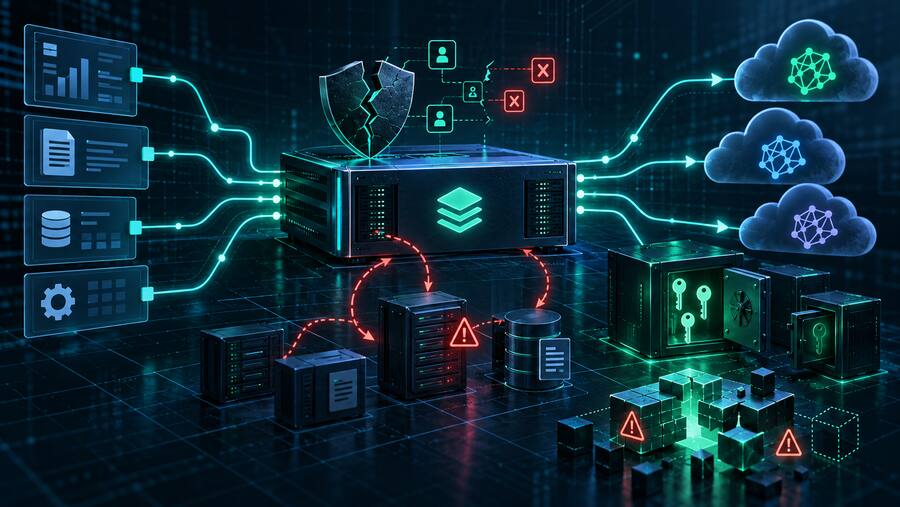







Sophos MDR’s latest case study is a useful reminder that attackers do not need exotic malware to slip past immature monitoring. In multiple early-2026 intrusions, Sophos observed a threat activity cluster using Deno — a legitimate JavaScript and TypeScript runtime — as a bring-your-own-runtime execution layer for malicious JavaScript payloads.
The important part is not that Deno itself is bad. It is not. The lesson is that adversaries are moving beyond the scripting engines defenders usually watch most closely. If a security program only has strong visibility for PowerShell, WScript, rundll32, and a narrow set of known malware families, a legitimate developer runtime can become a quiet post-compromise platform.
What Sophos reported
Across the cases Sophos analyzed, the initial access paths varied. Some activity involved ClickFix-style social engineering, some used web-triggered PowerShell execution, and one case used search-engine poisoning to push a fake PsExec MSI from a spoofed GitHub repository. Once execution began, however, the chain became much more consistent:
- PowerShell or command-based staging launched a malicious MSI installer.
- The MSI dropped VBS and PowerShell loader scripts into user-writable locations.
- The loaders used legitimate Windows utilities such as
msiexec.exe,wscript.exe,powershell.exe,curl.exe, andtar.exe. - The actor downloaded and extracted the legitimate Deno runtime.
- Deno executed obfuscated JavaScript payloads directly from encoded content, with broad permissions enabled.
Sophos described the pattern as a repeatable framework: malicious installer, native Windows tooling, Deno runtime deployment, in-memory JavaScript execution, host fingerprinting, persistence, and command-and-control communications.
Original source: Sophos — Abuse of alternative runtime environments Deno-tes defender headaches.
Why this matters for SMBs and government contractors
Most small and mid-sized organizations do not maintain a clean inventory of approved developer runtimes. That creates a blind spot. A workstation that suddenly installs Deno may look less alarming than an unsigned remote-access tool, but from the attacker’s perspective it can provide a flexible execution environment with file, network, and environment access.
For government contractors, the risk is sharper because the affected endpoints may touch proposal material, CUI workflows, Git repositories, cloud consoles, VPN portals, password managers, and customer systems. A BYOR tradecraft pattern can turn one user-driven execution event into a staging point for credential theft, reconnaissance, and follow-on access.
The defensive signal: runtime governance
This is really a runtime governance problem. Defenders should treat newly introduced scripting and developer runtimes as security-relevant events, especially on systems where those tools are not expected.
Practical detections should look for combinations like:
msiexec.exelaunching from browser-download paths, temporary directories, or user profile locations.- VBS or PowerShell loaders written under
%LocalAppData%,%AppData%, orC:\ProgramData. curl.exeortar.exeretrieving and extracting runtime archives shortly after suspicious installer execution.- Unexpected
deno.execreation or execution on non-developer endpoints. - Deno launched with broad permissions, especially
-Aor equivalent allow-all behavior. - Encoded JavaScript supplied inline rather than loaded from a normal project directory.
- HKCU Run key persistence pointing to script launchers or user-profile install paths.
Hardening recommendations
- Inventory approved runtimes. Know where Node.js, Deno, Python, Go, Java, .NET SDKs, and similar tooling are expected. Everything else should be explainable.
- Use application control where it fits. Block or alert on newly introduced runtimes executing from user-writable paths, especially on finance, HR, executive, and admin workstations.
- Monitor installer-to-script chains. MSI execution followed by WScript, PowerShell, curl, tar, and a new runtime should be treated as a high-confidence investigation path.
- Restrict broad runtime permissions. Developer tooling that can read files, environment variables, and network resources should not be allowed everywhere by default.
- Harden against ClickFix and SEO-poisoning lures. User training helps, but controls matter more: browser isolation, download reputation, EDR behavioral rules, and least-privilege workstations.
- Review developer endpoint access. If developer machines have standing cloud, repository, CI/CD, or VPN access, assume runtime abuse can become credential and source-code exposure.
Bulwark Black assessment
The Deno abuse pattern is another example of attackers adapting faster than default enterprise monitoring. The tool is legitimate, the installer format is native, and many of the command-line utilities are built into Windows. That makes the activity easy to miss if detections are built around static malware names instead of behavior.
The right takeaway is not “ban Deno.” The right takeaway is to know where powerful runtimes belong, alert when they appear somewhere unexpected, and investigate installer-to-runtime execution chains quickly. In 2026, runtime sprawl is part of the attack surface.