


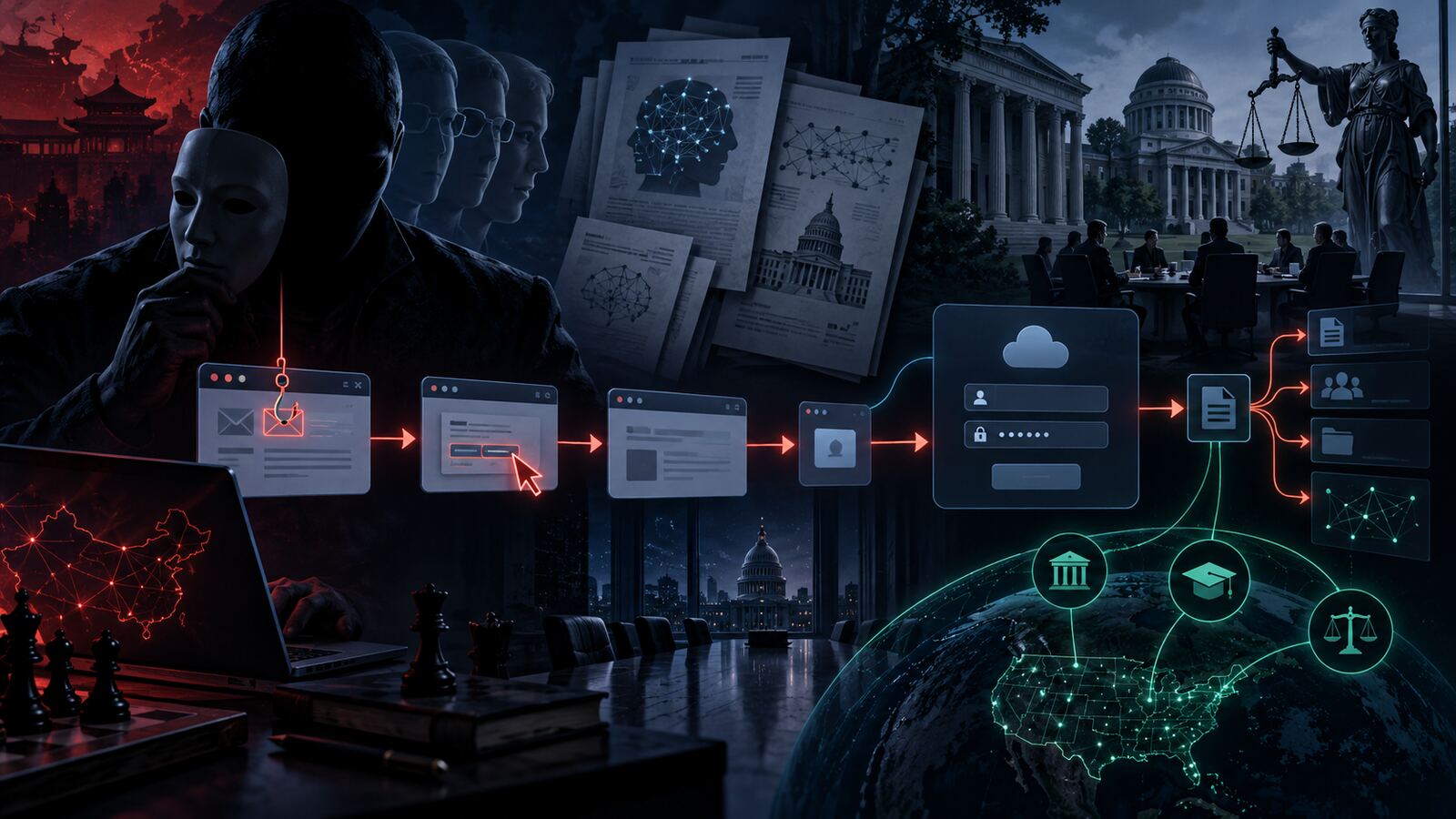
Proofpoint’s latest reporting on TA419 is a useful reminder that “AI security” is not only about model prompts, data leakage, or exposed inference servers. It is also about the people shaping AI strategy, procurement, regulation, export controls, and national-security policy.
According to Proofpoint, the China-aligned espionage actor it tracks as TA419 ran targeted credential-phishing campaigns in 2026 against AI policy experts at U.S. think tanks, universities, and legal-sector organizations. The lure was not crude malware spam. It was relationship-driven impersonation: emails posing as credible economists, former policy officials, or AI-sector insiders, followed by fake collaboration links once a target engaged.
What Proofpoint Reported
TA419 allegedly used benign “conversation starter” emails to build trust around AI policy themes, including fictitious advisory work and AI export-control discussions. If the recipient responded, the actor sent shortened links that redirected through actor-controlled infrastructure to a fake OneDrive experience and an adversary-in-the-middle credential phishing page.
The technical point that matters: this was designed to defeat ordinary password-and-MFA thinking. Proofpoint says the campaign relayed Microsoft 365 / Entra ID sign-in flows in real time, captured session material, and used a customized Browser-in-the-Browser style kit to make the experience look legitimate to the victim.
Why This Matters for SMBs and Government Contractors
Most small organizations will not have “AI policy fellow” in anyone’s job title. But the playbook is directly relevant to government contractors, legal teams, higher education, consulting firms, research partners, and SMBs supporting regulated or defense-adjacent work.
- The lure is credibility, not panic. The attacker does not need a fake invoice if they can impersonate someone the target would professionally want to answer.
- Policy work creates sensitive access. People involved in strategy, compliance, proposal work, export controls, legal review, or research partnerships often hold valuable email, document, and identity access.
- MFA is necessary but not sufficient. AitM phishing is built to steal live sessions after the user completes a real-looking login flow.
- AI makes the target map wider. Organizations using or advising on AI may become intelligence targets even if they are not traditional defense primes.
Defensive Takeaways
- Move high-risk users to phishing-resistant authentication. Passkeys, FIDO2 security keys, and other origin-bound methods are materially stronger against AitM phishing than push MFA or one-time codes.
- Treat unusual collaboration invites as identity events. Unexpected requests to join committees, review reports, access shared files, or comment on policy documents should be verified through a second channel.
- Harden Microsoft 365 session controls. Review conditional access, token lifetime policies, sign-in risk detections, impossible travel, unfamiliar device alerts, and suspicious OAuth/application activity.
- Monitor for file-sharing impersonation patterns. TA419 reportedly used cloud/file-sharing themes and redirect chains. Security teams should tune detections for newly registered domains, unusual URL shorteners, and anomalous OneDrive/SharePoint access.
- Train executives, researchers, attorneys, proposal teams, and program managers—not just IT. The people most likely to receive these lures may sit outside security-heavy roles.
Bulwark Black Assessment
This is the kind of campaign that should push organizations away from generic annual phishing training and toward role-based threat modeling. If an employee has access to contracts, policy discussions, export-control material, research partnerships, or AI strategy, they need stronger identity controls and a clear verification process for unsolicited professional outreach.
The practical lesson is simple: when the lure is credible and the login page is proxied in real time, the control that saves you is not user suspicion alone. It is phishing-resistant authentication, session monitoring, and a culture where verifying an unexpected request is normal—not awkward.