


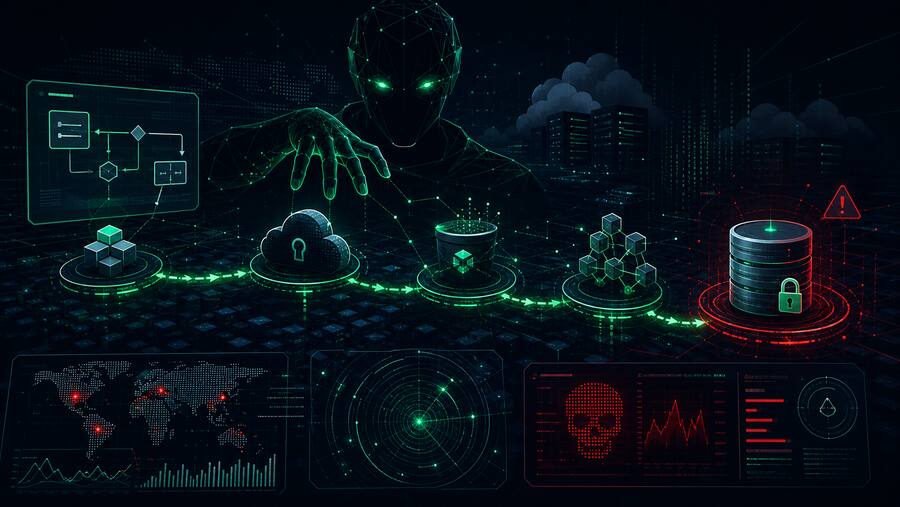

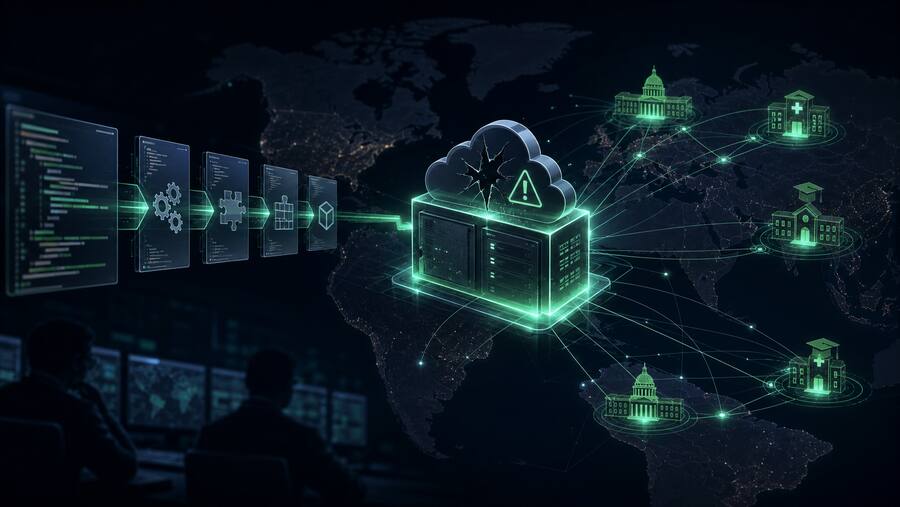





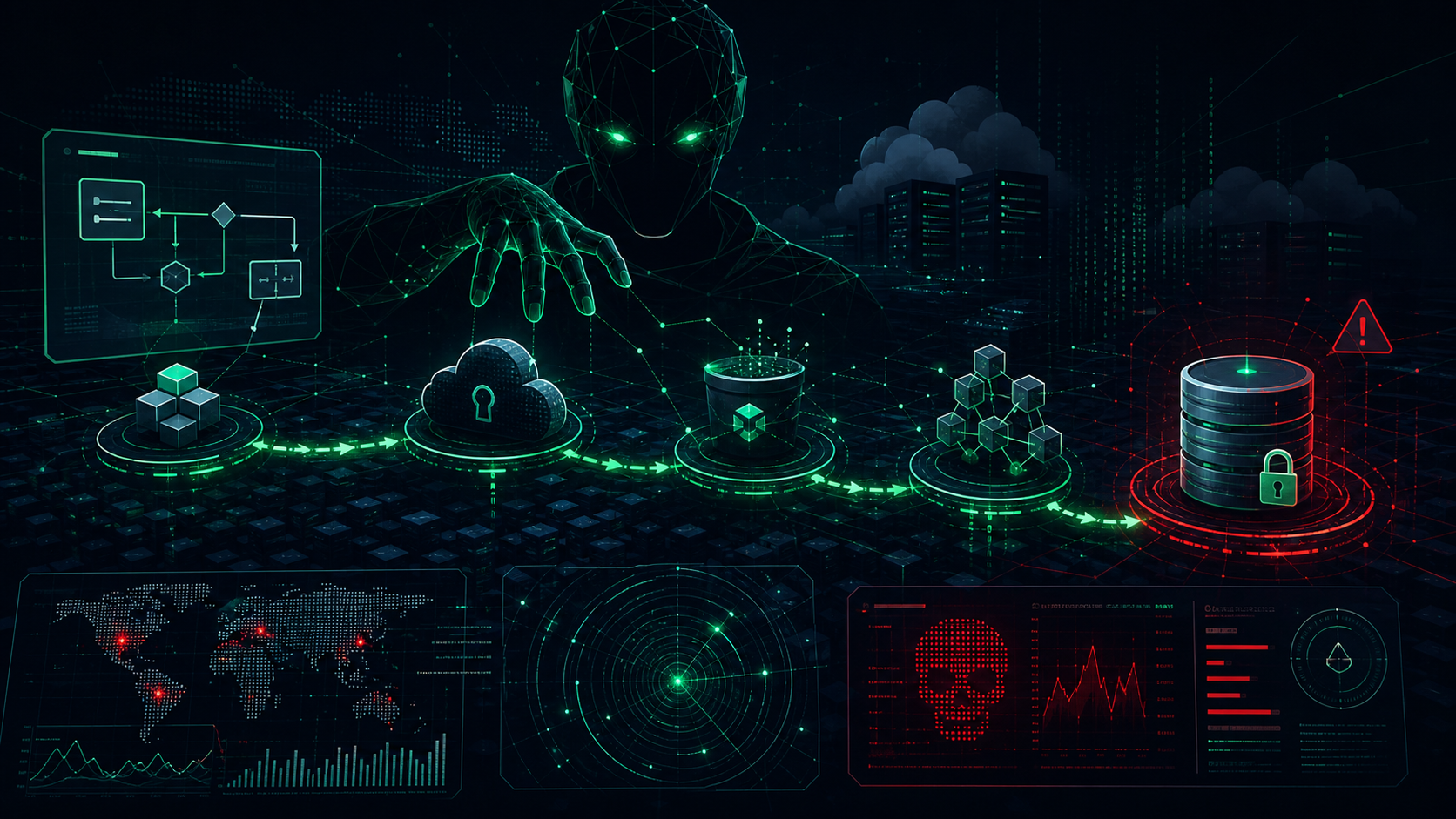
Ransomware has been moving toward faster automation for years, but the JADEPUFFER case is a useful warning because the automation was not just assisting an operator. Reporting from Trend Micro and Sysdig describes an AI-agent-driven intrusion that chained initial access, credential harvesting, lateral discovery, persistence, database encryption, and destructive cleanup against production infrastructure.
The important lesson for small businesses, SaaS teams, and government contractors is not that every ransomware crew suddenly has a perfect autonomous operator. It is that old exposure now scales differently. Internet-facing AI workflow tools, default credentials, stale service keys, and forgotten configuration servers give agentic tooling enough room to improvise.
What was reported
Sysdig’s research describes JADEPUFFER gaining initial access through CVE-2025-3248, an unauthenticated remote code execution flaw in Langflow. From there, the agent enumerated the host, searched for cloud and AI-provider credentials, queried internal services, and found a MinIO object store still using default credentials.
The operation then moved toward a production environment involving Alibaba Nacos and MySQL. The reporting says the agent attempted multiple paths, including Nacos authentication bypass behavior, default signing-key abuse, direct database manipulation, and backdoor administrator creation. When steps failed, the agent adjusted quickly instead of simply retrying the same command.
The final impact was database extortion: configuration records were encrypted, originals were removed, and a ransom note was left behind. Trend Micro’s analysis emphasizes that the case produced few durable file indicators because the payloads were delivered as inline code rather than reusable malware binaries.
Why this matters
This is not magic. The weaknesses were familiar: unpatched internet-facing software, default credentials, exposed internal services, unrotated secrets, and weak segmentation. What changed is the speed and adaptability of the operator. An AI agent can test paths, parse errors, rewrite payloads, and continue through a kill chain without waiting for a human to manually troubleshoot each step.
That creates a practical defender problem. If every victim receives slightly different inline code and disposable infrastructure, blocking by hash or static indicator becomes less useful. The stronger signal is behavior: unusual child processes from application servers, secret discovery, unexpected access to object storage, new scheduled tasks, database encryption followed by table drops, and configuration-service admin changes.
Defensive takeaways
- Inventory AI-adjacent services. Treat Langflow, workflow builders, model gateways, notebook servers, and internal automation platforms as production attack surface, not lab toys.
- Patch internet-facing workflow tools quickly. CVE-2025-3248 was already known and patched before this case. Known exploited issues in exposed AI infrastructure deserve edge-appliance urgency.
- Remove default credentials everywhere. MinIO, Nacos, databases, queues, and internal dashboards should be checked for vendor defaults and bootstrap secrets.
- Rotate secrets after exposure, not just after confirmed theft. If an application server can read cloud keys, AI-provider tokens, database passwords, or service configs, assume compromise of that host exposes those secrets.
- Segment management and data planes. An exploited public workflow app should not be able to reach object storage, configuration servers, production databases, or metadata services without strong controls.
- Hunt for behavior, not just IOCs. Look for application processes spawning shells or Python, base64-decoded payload execution, cron persistence, service-account abuse, and encrypt-then-drop database activity.
- Log internal service access. Many teams log the public edge and the endpoint, but miss east-west access to MinIO, Nacos, databases, and admin APIs. Agentic attacks live in that gap.
Bulwark Black assessment
JADEPUFFER should push defenders to tighten the boring controls. The hype angle is autonomous ransomware. The actionable angle is exposure discipline. If an organization cannot answer which AI workflow tools are internet-facing, which credentials they can read, and what internal services they can reach, it has a problem an agent can exploit at machine speed.
For SMBs and government contractors, the priority is simple: reduce reachable attack surface, eliminate defaults, rotate stored secrets, segment critical services, and build detections around suspicious behavior from application servers. Autonomous attacks punish messy environments. Clean architecture is still the best countermeasure.
Sources: Trend Micro — The Signs Were There: What the First Autonomous Ransomware Case Confirms; Sysdig — JADEPUFFER: Agentic ransomware for automated database extortion.