


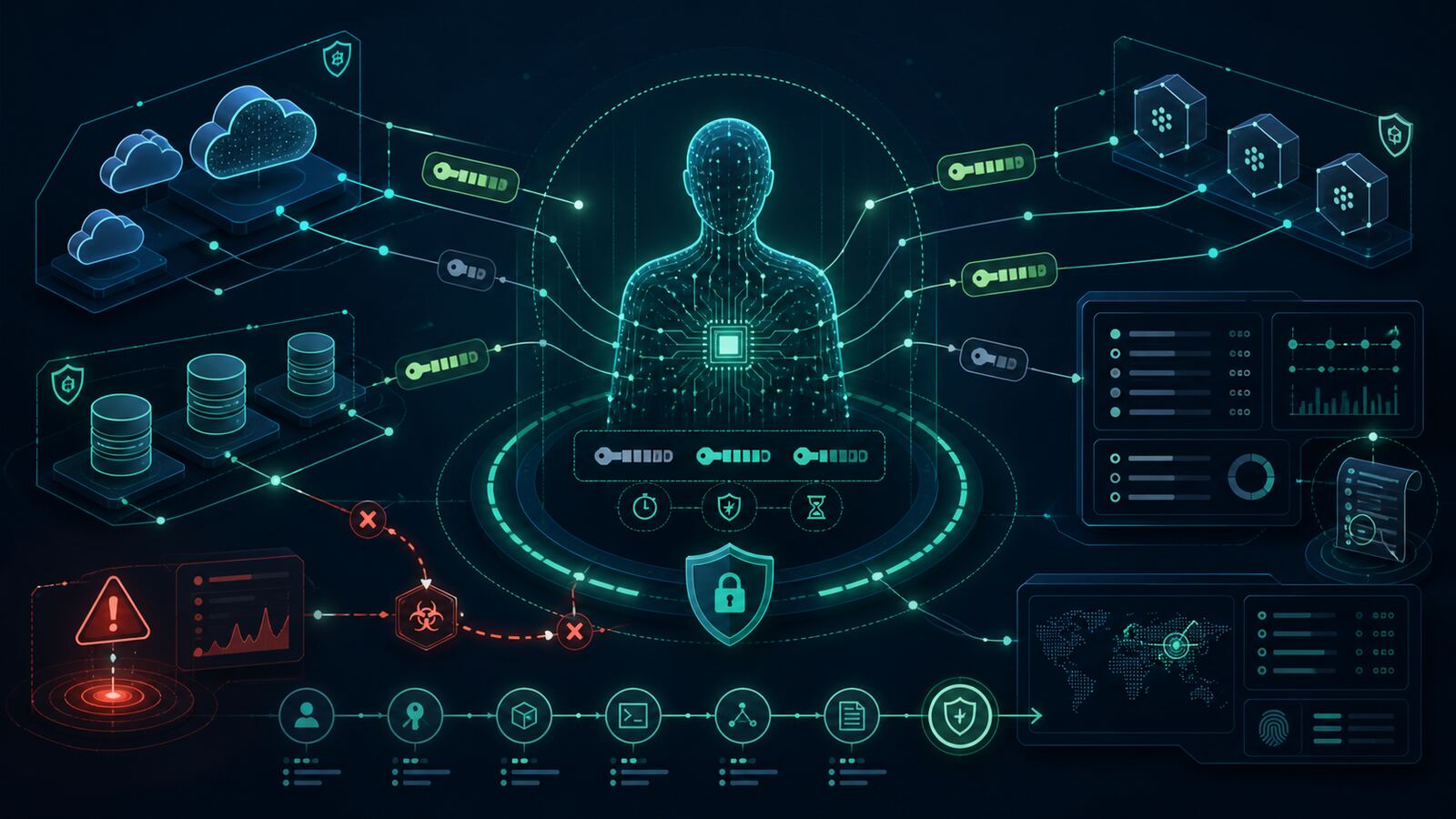
AI agents are starting to behave less like ordinary applications and more like temporary operators: they receive a task, use credentials, call tools, touch data, and sometimes delegate work. That creates a new incident-response problem. If an agent accesses the wrong database or invokes the wrong cloud API, the logs may show a valid service account doing an allowed action — while still leaving defenders unable to answer the more important question: was that action authorized for this task?
SC World’s risk advisory on AI-initiated access events frames the issue clearly: traditional incident response usually reconstructs who did what by correlating identity and activity logs. Agent response needs another layer: what task was the agent authorized to perform, which human or system initiated it, what resources were in scope, and whether the agent stayed inside that boundary.
What changed
In a normal account-compromise investigation, defenders can often start with the user, session, IP address, device, and accessed resources. AI agents complicate that model because they can operate at machine speed, outside human working hours, across multiple connectors, and under service credentials that may be broader than the work actually required.
The result is a gap between credential permission and task authorization. A cloud role may technically allow a marketing agent to query a customer database, call an external API, or create infrastructure. But if the original task was “review public campaign copy,” those actions are still out of bounds. The security failure is not always stolen credentials; sometimes it is an agent operating with more access than the task should have carried.
Why this matters for SMBs and government contractors
Small businesses and government contractors are already adopting AI-enabled tools for document review, proposal support, customer service, code assistance, ticket triage, and internal automation. Those tools often connect to email, file shares, CRMs, source repositories, cloud consoles, and SaaS APIs. If the organization cannot map agent activity back to the task that spawned it, an incident can look legitimate until the damage is done.
This is especially important for CMMC- and contract-sensitive environments. Controlled unclassified information, proposal data, HR records, source code, and customer systems should not be reachable simply because an agent’s service account has broad default permissions. Agentic automation needs the same discipline expected of privileged users: least privilege, monitoring, change control, and fast containment.
Defensive takeaways
- Log the task at agent creation. Capture who requested the agent, the approved task, the authorized data sources, allowed tools, expected runtime, and business justification. Without this, investigation stops at “the service account did it.”
- Issue task-scoped credentials. Avoid long-lived broad service accounts. Use temporary credentials, session policies, conditional access, and resource constraints tied to the specific task.
- Detect scope violations. Alert when an agent touches resources, APIs, tenants, repositories, or external services that were not listed in the task manifest.
- Watch delegation chains. If one agent can spawn another, pass tokens, call plugins, or hand work to third-party services, preserve that chain as evidence. Downstream delegation is where blast radius can grow quickly.
- Contain with precision. Token revocation, session termination, and deny-all policy overrides all have different propagation delays and operational side effects. Build a runbook before the first incident.
- Preserve ephemeral evidence fast. Containers, serverless executions, temporary logs, tool manifests, prompts, inputs, API responses, and credential issuance events may disappear quickly. Collection should begin in the first hour.
Bulwark Black assessment
The security model for AI agents should not be “trust the agent because the credential is valid.” It should be closer to just-in-time privileged access: define the task, grant only what the task needs, log the authorization chain, and revoke access when the task ends.
For SMBs and government contractors, the immediate move is practical: inventory AI tools with access to business data, identify their service accounts and connectors, and require task-level logging for any agent that can touch sensitive systems. If you cannot answer what an agent was supposed to do, you will struggle to prove whether it misbehaved.
Original source: SC World — “When an Agent Fails: Incident Response for AI-Initiated Access Events”.