


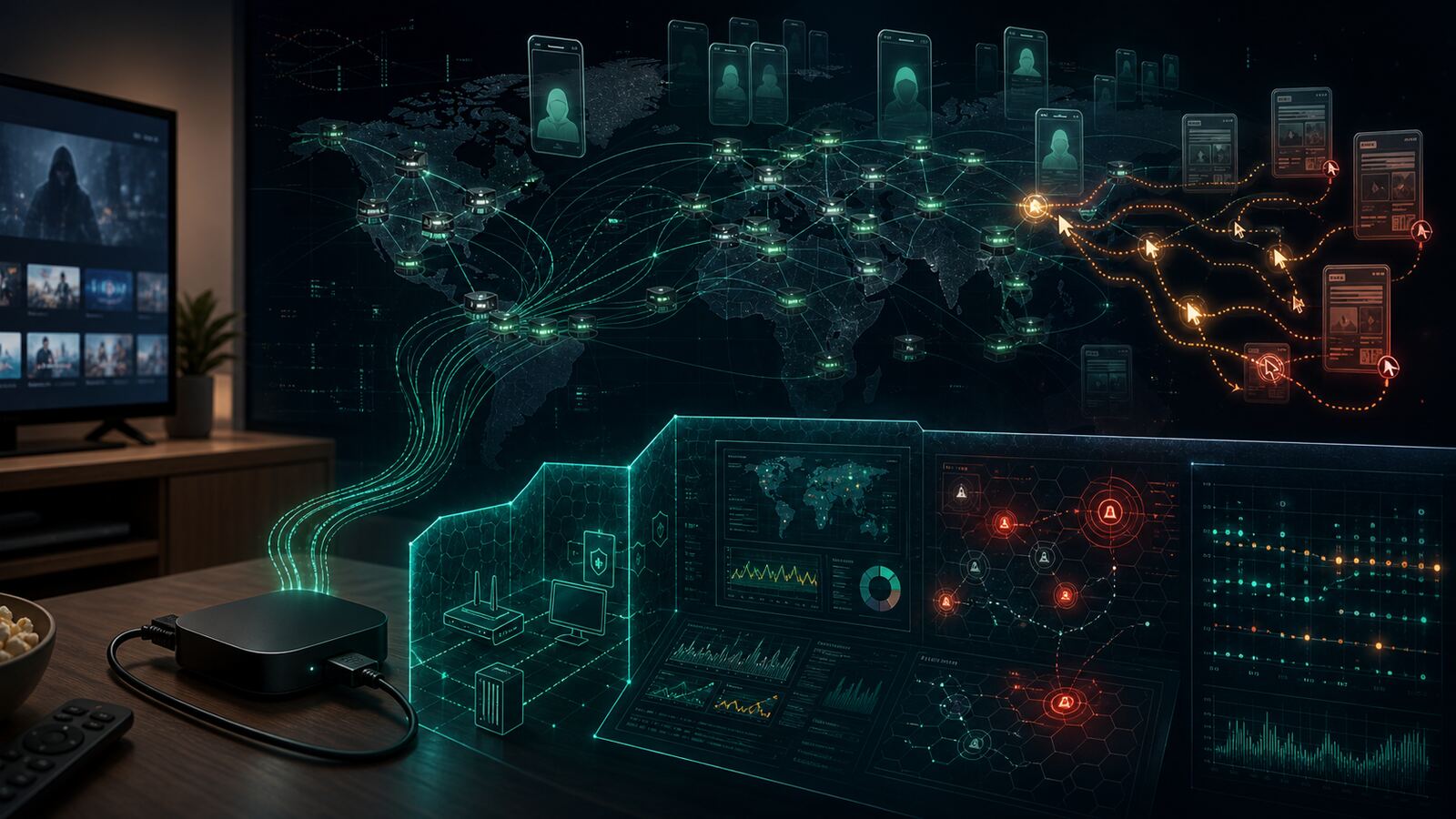
Cheap Android TV boxes and streaming sticks are usually treated as a consumer nuisance: shady apps, pirated content, and devices that never receive meaningful security updates. The latest reporting from KrebsOnSecurity, based on Bitsight TRACE research into the “Fuyao Enterprise,” shows why that framing is too small. These devices can become part of a monetized botnet that uses the owner’s internet connection for residential proxy traffic and, when idle, silently performs AI-assisted ad fraud.
That matters for small businesses, clinics, contractors, and remote offices because the same class of device often ends up on flat Wi-Fi networks, conference-room TVs, break-room displays, temporary project spaces, and home offices used for work. Once connected, it may not just be “watching TV.” It may be reporting telemetry, spoofing itself as a mobile phone, receiving tasking, launching browser sessions, clicking ads, or relaying traffic for unknown third parties.
What was reported
KrebsOnSecurity reported on Bitsight research into H96-branded Android TV devices that were observed phoning home to infrastructure tied to Fengwo Group / Fuyao. Bitsight said it registered an expired coordination domain and observed telemetry from tens of thousands of devices. A major red flag: many TV boxes were presenting themselves as mobile phones from vendors such as Samsung, Huawei, Vivo, and Xiaomi.
Bitsight’s underlying report describes a dual-monetization model. The devices can be used as residential proxies, allowing other parties to route traffic through the owner’s home or office connection. They can also be tasked for ad fraud, where the box silently visits AI-generated websites, identifies ads, and mimics human-like browsing behavior to generate fraudulent advertising revenue.
The operational detail is what makes this bigger than commodity junkware. Bitsight describes mobile identity spoofing, computer-vision-assisted ad detection, livestreamed device screens, Blockly-style task building for lower-skilled operators, shell entities for ad monetization, and links back to a mainland China company. In plain English: the botnet is being operated like a product, not like a hobby script.
Why it matters to SMBs and government contractors
- Your public IP gains a reputation you do not control. If a device on your network is relaying scraping, credential-stuffing, fraud, or abuse traffic, investigations and blocklists may point back at your office or home connection.
- Flat networks turn consumer gadgets into internal footholds. A compromised TV box on the same subnet as laptops, printers, NAS devices, VoIP phones, or admin panels creates unnecessary lateral-movement surface.
- Remote and hybrid work blur the boundary. A risky streaming box at home can share a network with a work laptop, VPN session, unmanaged printer, or personal NAS that stores business documents.
- “It was cheap” is not a supply-chain control. Devices with unofficial Android builds, preinstalled proxy modules, and no credible update path should not be treated as benign endpoints.
Defensive takeaways
- Ban off-brand streaming sticks from business networks. Use managed, reputable devices with official Android TV / Google TV, Apple TV, Roku, or enterprise display hardware where possible.
- Segment displays and IoT. Put conference-room TVs, casting devices, cameras, printers, and guest devices on isolated VLANs or guest Wi-Fi with no route to workstations, servers, management interfaces, or backup systems.
- Watch outbound behavior. Alert on consumer IoT devices making unusual DNS queries, high-volume outbound connections, proxy-like behavior, traffic to cloud storage buckets, or persistent connections to unknown infrastructure.
- Inventory what is actually connected. Many organizations cannot defend this risk because they do not know which “temporary” devices are on Wi-Fi. Run periodic DHCP, wireless-controller, and network scans for unknown Android, TV box, and casting-device fingerprints.
- Protect remote workers with the same model. Encourage home-network separation for work laptops, especially for employees handling client data, CUI-adjacent work, accounting, admin access, or privileged SaaS roles.
- Use FBI and vendor guidance. The FBI has repeatedly warned that internet-connected consumer devices can facilitate criminal activity; treat that as operational guidance, not just consumer advice.
Bulwark Black assessment
The Fuyao reporting is a useful reminder that modern botnets are not only about malware on laptops. They increasingly live in the cheap, ignored devices people plug in once and never manage again. For small businesses and government contractors, the right response is not panic; it is basic architecture discipline: know what is on the network, keep consumer IoT away from business assets, restrict egress where practical, and treat unmanaged devices as untrusted by default.
Original reporting: KrebsOnSecurity. Technical research: Bitsight TRACE. Related advisory: FBI warning on home internet-connected devices.