














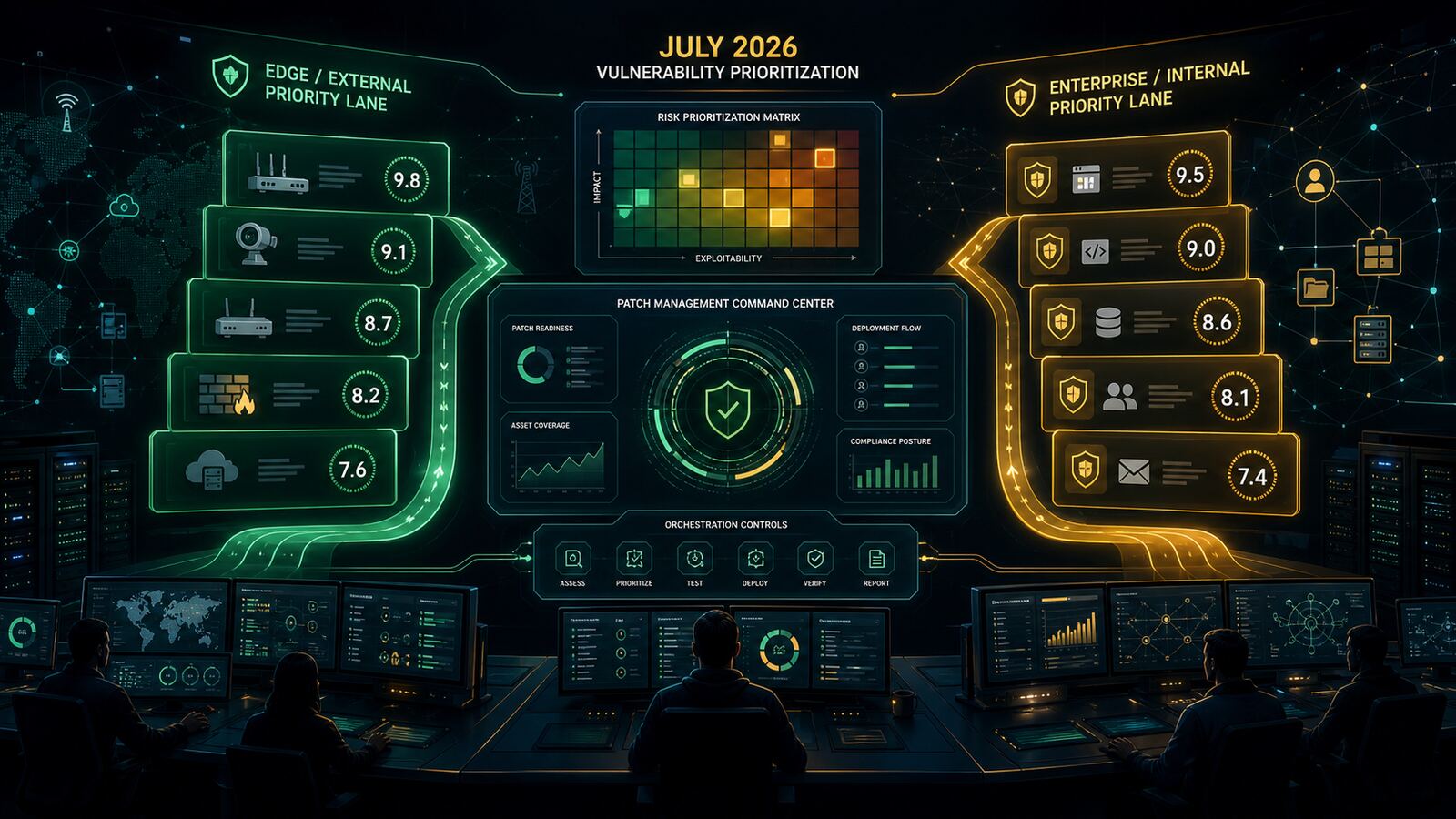
Vulnerability management teams do not fail because they lack CVE lists. They fail because every list looks urgent, every vendor alert sounds critical, and small teams have to choose what gets patched first. Recorded Future’s July 2026 CVE landscape is useful because it cuts through that noise: the month was not just busy, it was packed with vulnerabilities that were already exploited or operationally weaponized.
For small businesses, MSP-supported environments, healthcare practices, municipalities, and government contractors, the lesson is straightforward: severity scores matter, but they are not enough. Patch priority needs threat context, exposure context, and business context.
What Recorded Future reported
Recorded Future’s Insikt Group identified 85 high-impact vulnerabilities from July 2026 that defenders should prioritize. The report says 36 carried a “Very Critical” Recorded Future Risk Score, 26 were surfaced through CISA’s Known Exploited Vulnerabilities catalog, 55 came from vendor reporting, and four were identified primarily through honeypot data.
The spread matters. The affected products covered 61 vendors, including enterprise software, security appliances, network infrastructure, developer tooling, cloud platforms, collaboration systems, WordPress/Joomla ecosystems, and embedded devices. That is exactly the kind of mixed environment many SMBs and contractors actually run.
The most important operational signal: Recorded Future said 57 of the 85 vulnerabilities enabled remote code execution, and public proof-of-concept exploits or scanners existed for 60. The report also highlighted old weaknesses still being abused, with some vulnerabilities at least five years old and the oldest roughly 18 years old.
Why this matters
Attackers are not waiting for perfect zero-days. July’s picture shows a practical adversary pattern: abuse exposed edge devices, exploit internet-facing enterprise applications, recycle old RCEs where patching lags, and use public PoCs to scale quickly. That is bad news for organizations that patch by calendar date, CVSS score alone, or whichever vendor sends the loudest email.
For government contractors, there is an added compliance angle. If an exploited vulnerability leads to compromise of systems touching client data, CUI-adjacent workflows, identity providers, remote access, ticketing, or cloud administration, the incident can quickly become more than an IT cleanup problem. It becomes a contractual, reporting, and trust problem.
Defensive takeaways
- Patch internet-facing RCE first. Prioritize VPNs, firewalls, RMM tools, identity systems, web apps, CMS platforms, collaboration servers, and anything reachable from the public internet.
- Use exploitation evidence, not CVSS alone. CISA KEV, vendor exploitation notes, threat-intel reporting, honeypot activity, and public PoC availability should move a CVE up the queue.
- Separate emergency patching from normal maintenance. If a vulnerability is exploited in the wild and your asset is exposed, do not wait for the monthly patch window unless compensating controls are already proven.
- Inventory edge and forgotten systems. Old routers, DVRs, wireless controllers, CMS plugins, backup appliances, and “temporary” servers are where stale vulnerabilities survive.
- Track vendor and supplier exposure. MSP platforms, hosted portals, SaaS integrations, WordPress vendors, and managed infrastructure can create inherited risk even when your own endpoints are clean.
- Plan post-patch review for exploited appliances. For edge devices and management systems, patching may close the door after the attacker has already entered. Rotate credentials, review admin accounts, inspect logs, and check persistence paths.
A practical prioritization model
If your team cannot patch everything at once, use a simple scoring stack:
- Is it exposed? Public internet, partner access, VPN path, or reachable from untrusted networks.
- Is exploitation confirmed? KEV listing, vendor advisory, threat-intel report, honeypot signal, or credible incident activity.
- Is working exploit code available? Public PoCs, scanners, Metasploit modules, or mass-scanning chatter.
- What would compromise unlock? Identity, remote access, admin consoles, customer data, build systems, backups, or CUI workflows.
- Can you reduce exposure immediately? Disable the feature, restrict IP access, enforce MFA, isolate the host, block routes, or take the system offline until patched.
Bulwark Black assessment
The July 2026 CVE landscape reinforces a boring but important truth: patch management is not an administrative chore; it is active threat defense. The organizations that do best are not the ones with the longest spreadsheet. They are the ones that know what they expose, understand which vulnerabilities attackers are actually using, and can move fast when a control-plane system is at risk.
Original source: Recorded Future — July 2026 CVE Landscape.